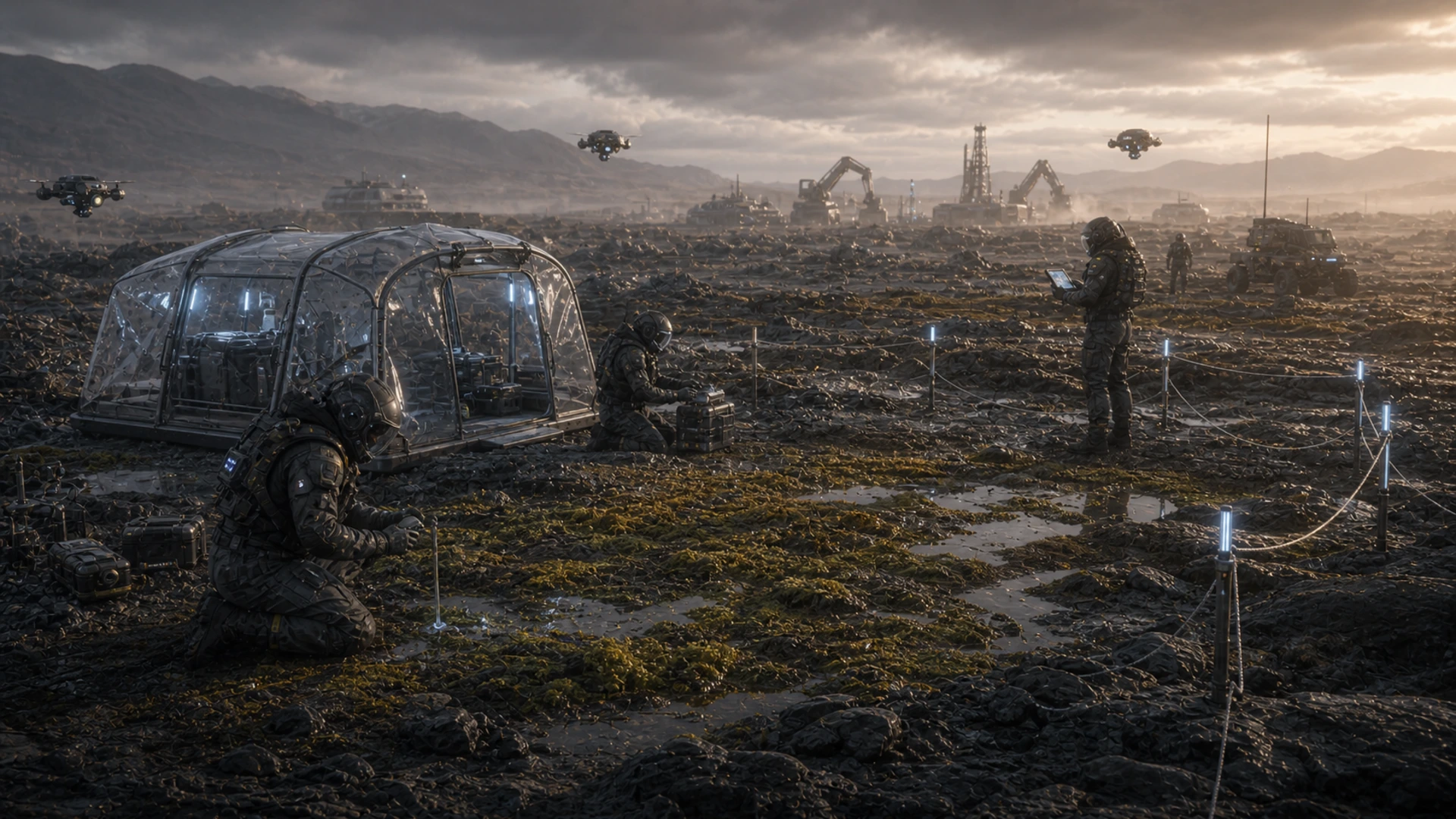
Trace Life Containment
Mission Control files this technical file as operational evidence for CT-03. A technical briefing on trace-life containment and native signal protection, defining the threshold, failure mode, and indicator impact Operators must audit. The record keeps the local Sector decision visible to neighboring Sectors, CRADLE-0 review, public indicators, and First Generation observers.
Operational Premise
The immediate premise is that one irreversible contact can erase a signal before it is understood. A sector can measure the symptom in a single cycle, but the consequence moves through energy supply, water handling, atmosphere processing, soil chemistry, civic trust, and faction interpretation. Mission Control therefore records the issue as a public systems briefing. It must be understandable to players in ten seconds, but it must also hold up as part of the wider story bible.
Sector Responsibility
The Operator's task is to keep a local system stable enough to contribute valid evidence. That can mean building redundancy, delaying activation, publishing a confidence interval, or accepting a temporary production loss. None of those actions wins the planet alone. Their value appears when many sectors submit comparable data and the global model can distinguish real recovery from noise.
For this topic, the practical player-facing choice is to choose between wider buffers and supervised crossing. The fast route can produce visible progress and satisfy short-term needs. The cautious route can protect evidence, trust, and long-term reversibility. Neither is written as a pure reward path. The best Last Cradle content makes both routes defensible, then shows what each route underestimates.
Global Feedback
The first global feedback target is ecological stability. The article should also point toward at least one secondary consequence: pollution pressure, research confidence, AI coordination, population capacity, or civic trust. A local decision becomes meaningful only when it moves through this loop: sector action, telemetry validation, public indicator update, faction dispute, global project adjustment, then a new constraint returning to ordinary sectors.
CRADLE-0 participates by clustering anomalies and publishing risk thresholds. It should not be portrayed as emotional, omniscient, or villainous. Its recommendations matter because the math is useful, not because the AI has moral ownership of the future. When a human review board disagrees with CRADLE-0, the content should describe the evidence and the cost, not turn the disagreement into melodrama.
Faction Use
Faction pressure should remain a conflict over routes. Cradle Authority may defend emergency coordination. Terraform Union may prefer large engineering throughput. Native Balance Institute may slow work to protect uncertain ecology. Free Settlers may defend local autonomy. Archive Church may argue that Earth memory has civic value. Silent Core may ask whether machine coordination is being trusted in the wrong places.
A strong faction paragraph states what each side protects and what harm each side risks. It should not label one side as good or evil. The reader should come away with a sharper understanding of why the choice is difficult, not with a simplified enemy list.
CRADLE-0 Review Note
Recommended review cadence: publish current evidence, confidence band, affected indicator, likely failure mode, and next cycle check. If the number improves but confidence drops, say so. If construction slows but evidence improves, say so. A civilization backup does not become credible by hiding its tradeoffs. It becomes credible by showing that the new society can measure, argue, and revise without losing sight of survival.
<!-- facility-package:start -->
Technology Facility Package
Technical Overview
Trace life containment is a boundary facility for uncertain ecology: it protects samples, workers, and public language from moving faster than evidence.
Use Cases
Use it for buffer zones, wetland holds, echo-rift signal work, public risk embargoes, and low-intrusion exploration.
Failure Modes
Failure can be overcontact, overnaming, false confidence, or indefinite closure that turns caution into unaccountable control.
Linked Regions
- `world/mist-wetlands`
- `world/echo-rift`
Mission Logs
- `logs/native-trace`
- `logs/mission-log-025-buffer-line`
- `logs/mission-log-035-trace-embargo`
Chronicle And Faction Dispute
- `chronicle/public-statement-native-grid-pause`
- `chronicle/worldline-report-native-buffer-zones`
- `chronicle/worldline-report-trace-life-embargo`
Demo Hook
The Demo hook is a boundary toggle with cost: widen the buffer, supervise crossing, or publish uncertainty and accept slower construction.
Visual Archive
Use the trace-life image as a high-resolution containment plate focused on field boundaries, not alien spectacle.
<!-- facility-package:end -->